











Should you become a PayFac? The real question is what you build yourself
If you run a platform, marketplace, or software product, you’ve probably come across the advice that becoming a Payment Facilitator (PayFac) is a long, expensive, regulator-heavy road, and most platforms are better off plugging into someone else’s. It’s a comfortable answer. It’s also incomplete.
The full PayFac route is more achievable than conventional wisdom suggests, provided you have the right acquiring partner doing the heavy lifting behind you. This guide walks through what a PayFac actually is, where the embedded-payments shortcut quietly costs you, and what’s really standing between your platform and owning your own payments infrastructure.
What a PayFac actually is
A Payment Facilitator is a business that becomes the “main merchant” for a group of smaller businesses. Instead of every merchant on your platform applying separately for their own merchant account with an acquiring bank, you onboard them under your own umbrella. They get a fast, simple setup; you take on the responsibility for their onboarding, compliance, and risk.
Think of it like the difference between a long-term office lease and a flexible workspace provider. In the old model, every business that wants a desk negotiates directly with the landlord, which means months of paperwork, credit checks, approvals. A PayFac is the provider who’s already done that work with the landlord, so new tenants can move in within hours.
In Europe specifically, this isn’t a status the card networks hand out the way they do in the US. It’s tied to regulation: to operate as a PayFac in the EU, you need to be authorised as a Financial Institution (FI) or Electronic Money Institution (EMI), because handling third-party funds is a regulated activity. That single fact is the source of most of the hesitation, and most of the misunderstanding, about what becoming a PayFac actually involves.
Why many platforms stop at embedded payments
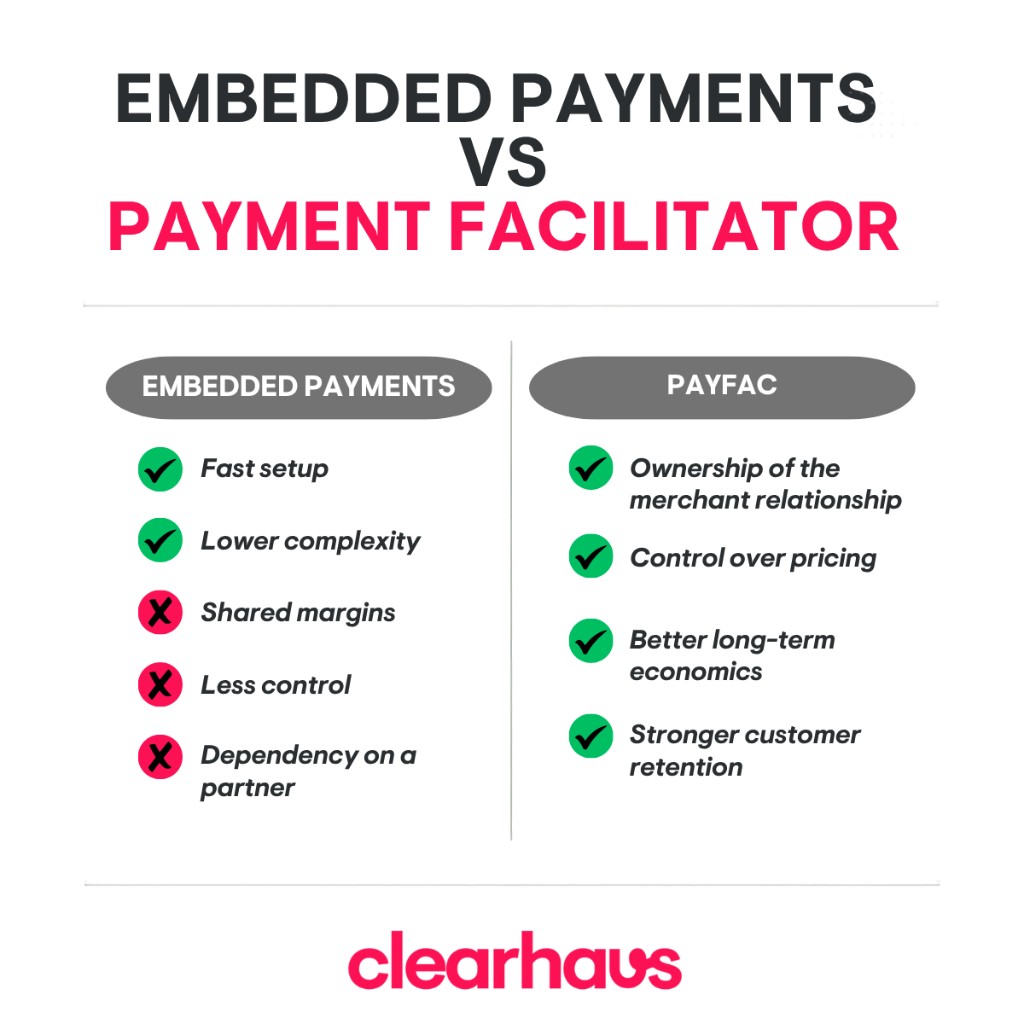
The case for skipping full PayFac status and going straight to embedded payments is genuinely reasonable, as far as it goes. You launch in weeks instead of months. A licensed partner absorbs the KYC, AML, and regulatory obligations. You get most of the look and feel of owning payments without becoming a regulated entity yourself.
What that pitch tends to leave out is what you give up to get there. You share your margin with that partner permanently, not just for a launch period. You’re dependent on their roadmap, their risk appetite, and their pricing decisions, not yours. And the merchant relationship, the actual asset that makes a platform sticky, sits partly outside your control.
For an early-stage platform still proving out its core product, that trade is often the right one. For a platform where payments are becoming central to the business, it’s a trade that gets more expensive every year you stay in it.
When owning payments starts to matter
Embedded payments is often the right place to start. Full PayFac status is where ambitious platforms grow into, once payments stop being a feature and start being the business. It’s about which parts of your business you own outright.
You own the merchant relationship and the data that comes with it, instead of routing it through a partner’s systems. You set your own commercial terms instead of working within someone else’s margin structure indefinitely. And because payments become genuinely embedded in your product rather than bolted on through a third party, switching away from your platform becomes a real operational decision for your merchants, not a one-click migration.
The real barrier is the infrastructure, not the license
Here’s where the conventional wisdom blurs two very different things together.
One part of becoming a PayFac is the license: your FI or EMI authorisation, your compliance programme, your KYC and risk function. That’s the strategic asset. It’s also the part you’d want to own regardless of how you handle payments, because it’s what lets you set the terms of your own merchant ecosystem.
The other part is the acquiring infrastructure underneath it: card network registration, sponsor bank relationships, settlement systems, reconciliation, payouts, connectivity to dozens of payment gateways. That’s the expensive, slow, operationally heavy part, and it’s also the part that has nothing to do with your product or your merchants. It’s plumbing.
The conventional wisdom treats both halves as one undifferentiated wall and tells you to avoid the whole thing. The more useful framing is to keep the strategic half and hand off the plumbing to someone who already built it.
Build the business, not the acquiring infrastructure
This is exactly the gap Clearhaus, part of the Unzer Group, is built to close. As Europe’s first Danish acquirer to offer a dedicated PayFac solution, Clearhaus lets businesses that hold or are pursuing an FI or EMI license plug directly into licensed acquiring infrastructure, rather than building it themselves.
The role split is clean. The PayFac is responsible for merchant onboarding, KYC, AML, ongoing monitoring and first-line risk management, while Clearhaus fulfils its responsibilities as the acquiring partner: Visa and Mastercard acceptance, recurring and subscription payment support, automated settlement and reconciliation, configurable payouts across currencies, and connectivity to more than 30 payment gateways, all through an API-first integration. Your merchants only ever see you. The acquiring relationship sits quietly behind your platform.
The credibility behind that offer isn’t new. Clearhaus has handled transactions for more than 42,000 online stores across 33 European countries, operating its own technical infrastructure under licenses from the Danish Financial Supervisory Authority, Visa, and Mastercard, since acquiring its first customer in 2015. It’s also extended that infrastructure to physical stores, so platforms can run online and in-person payments through the same setup. The aim is to help businesses stay in control and keep payments simple.
Where the Clearhaus model is different
Three things set Clearhaus apart from the usual build-versus-partner maths. The first is cost structure: there’s no setup fee and no monthly fee from Clearhaus to stand up the model. You pay per transaction, not for the privilege of building on the infrastructure. The acquiring layer that’s normally the most capital-intensive part of going PayFac carries no upfront ticket here.
The second is control at the merchant level: each of your sub-merchants gets its own MID rather than being pooled under a single master account, which keeps risk cleanly isolated between merchants, avoids the ceilings of pure aggregation, and scales as your larger merchants grow.
The third is reach: you can operate across the European Economic Area (EEA) as well as the UK, so a platform serving merchants in several markets runs them through one acquiring relationship instead of stitching together a different one country by country.
Why this matters across Europe right now
Europe’s payments landscape is becoming more digital, platform-driven and fragmented at the same time. Merchants increasingly expect digital-first onboarding as the default, not a differentiator, and the platforms that serve them are growing into genuine payment ecosystems. If your platform already manages meaningful merchant volume across one or more European markets, you may be closer to PayFac-ready than the standard advice gives you credit for.
Is your platform ready to become a PayFac?
One thing isn’t optional: in Europe, operating as a PayFac means holding an FI or EMI license. If you have one, or you’re close, the rest is about readiness. The more of these that apply, the closer you are:
- You already onboard and manage merchants on your platform
- You have, or could build, a compliance and risk function
- You already are a PayFac and want better economics and more control
- You are not a PayFac, but payments are becoming a real revenue line for you, not just a supporting feature
- You’d rather own your merchant pricing and keep the margin than leave it with a third-party acquirer
- You’re serving, or plan to serve, one or more markets across Europe
If several of these fit, you’re likely closer than you think. The part that looks hardest from the outside – the acquiring infrastructure – is exactly what Clearhaus is built to provide.
Talk to our partner team to explore whether the PayFac model is the right fit for your platform.